United Kingdom · Coity Higher
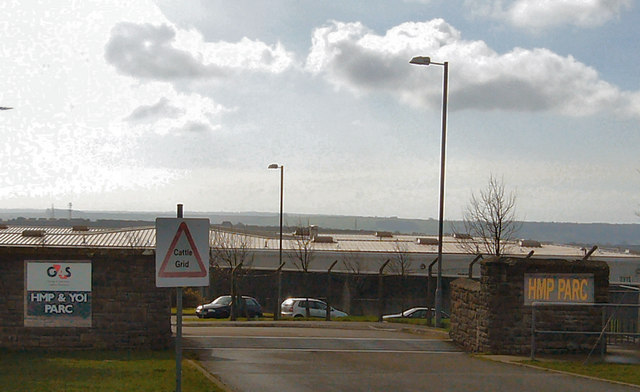
HM Prison Parc
Data is aggregated from public sources and may be incomplete or out of date. Always verify with primary sources before acting on any figure. See data sources.
For families
How to send mail, money, and visit HM Prison Parc
Step-by-step guidance using the United Kingdom system — addresses, money services, visit booking, what to bring on your first visit.
Background
HM Prison Parc (Welsh: Carchar Parc EF) is a Category B men's private prison and Young Offenders Institution in Bridgend, Mid Glamorgan, Wales. It is operated by G4S, and is the only privately operated prison in Wales.
Source: Wikipedia article lead, CC-BY-SA.
Capacity
—
Current population
—
Occupancy
—
Year opened
1997
Operational
Figures from official sources · verified 22 May 2026 · methodology
Facility profile
Operator
G4SPopulation held
Male
Opened
1997
Region
Coity Higher
Security level
—
Death-row facility
No
Conditions
This review visit followed up on the concerns we raised at our last the following judgements about outcomes for prisoners. Figure 1: HMP Parc healthy prison outcomes in 2022 and 2025 deterioration in standards across all of our healthy prison tests. Once Parc had experienced significant challenges following leadership and contractual changes. Staff turnover had subsequently increased, and morale declined.
Visiting
This review visit followed up on the concerns we raised at our last What we found during this review visit This review visit followed up on the concerns we raised at our last As this report and our recent visits show, the YOI at Parc is the best in England weekend visits, that encouraged family contact and sat alongside other
Mailing
Underpinning Parc’s success were the excellent relationships between young was that, in keeping with other YOIs, the number of children held at the time of
Practical info
HMP Parc is a category C resettlement prison holding convicted adult Note: rehabilitation and release planning became ‘preparation for release’ in October 2023. high. Prisoners reported frustration with inconsistent regimes and long to 21 hours a day. There were delays in allocating prisoners to work, training or education, and they were frustrated with the lack of However, as a result of persistent staffing constraints and regime Partnership working, both between providers and among departments, was working much more effectively to tackle the challenges that we mental health difficulties and addiction to drugs or alcohol.
Known issues
The prison was severely affected by drug ingress, with a particular risk posed by drones, which contributed to a cluster of deaths linked to synthetic opioids and several self-inflicted deaths in early 2024. At the time of the inspection, levels of violence and self-harm were drugs; secure window installation was progressing well, and leaders had been a decline in drug use. mental health difficulties and addiction to drugs or alcohol. At our last Parc was also severely troubled by the ingress of drugs, with a particular risk posed by the incursion of drones.
Contact & address
No public contact details available.
Conditions Risk Score
Derived signal — not a judgement. How it's calculated
- Overcrowding
- 0/30
- Oversight reports
- 26/30
- Structural flags
- 10/15
- Death signals
- 10/15
- Conditions text
- 0/10
What the score is responding to:
- · 7 oversight reports in the last 5 years
- · Privately operated under contract
- · Substantial documented known-issues record
- · Multiple in-custody-death signals in sources
This facility scores 46. The national average across 584 scored United Kingdom facilities is 4 — 42 points above national average.
Related facilities
Same country, matched on type + security level where possible.
- HMP WandsworthLondonHighLocal159% occupancy
- HMP FranklandDurhamMaximumLocal100% occupancy
- HMP BarlinnieGlasgowHighLocal147% occupancy
- HMP Cookham WoodKentHighLocal
- HMP PentonvilleLondonHighYOI137% occupancy
- HMP StyalWilmslowHighClosed female
Reports
- HMIP5 Jan 2026
1.1 HMP Parc is a category C resettlement prison holding convicted adult men, young offenders, and convicted and remanded sex offenders. The prison also has a small unit for children, which we inspect separately. 1.2 This review visit followed up on the concerns we raised at our last inspection of HMP Parc in January 2025. What we found at our last inspection 1.3 At our previous inspections of HMP Parc in 2022 and 2025, we made the following judgements about outcomes for prisoners. Figure 1: HMP Parc healthy prison outcomes in 2022 and 2025 Note: rehabilitation and release planning became ‘preparation for release’ in October 2023. 1.4 At the last inspection, in January 2025, we found a serious deterioration in standards across all of our healthy prison tests. Once considered one of the most successful prisons in England and Wales, Parc had experienced significant challenges following leadership and contractual changes. Staff turnover had subsequently increased, and morale declined. 1.5 The prison was severely affected by drug ingress, with a particular risk posed by drones, which contributed to a cluster of deaths linked to synthetic opioids and several self-inflicted deaths in early 2024. 1.6 At the time of the inspection, levels of violence and self-harm were high. Prisoners reported frustration with inconsistent regimes and long periods of confinement, with too many men locked in their cells for up to 21 hours a day. There were delays in allocating prisoners to work, training or education, and they were frustrated with the lack of progression in their sentence. Report of an independent review of progress at HMP Parc What we found during this review visit 1.7 While we found insufficient progress in over half of the concerns we reviewed, we also saw committed leaders (see Glossary) and staff making genuine efforts to drive improvement, which was encouraging. However, as a result of persistent staffing constraints and regime limitations, improved outcomes in some areas had not yet been achieved. 1.8 Leaders had put considerable efforts into reducing the ingress of illicit drugs; secure window installation was progressing well, and leaders were making good use of technology and resources. As a result, there had been a decline in drug use. 1.9 Partnership working, both between providers and among departments, was working much more effectively to tackle the challenges that we had identified. Leaders had better oversight, and were now using data to drive improvements, particularly within the areas of safety and
- HMIP6 Jan 2025
While this report exposes a serious deterioration in standards at this large category C prison in South Wales, it also highlights some more positive, early signs of recovery under the determined leadership of the director, who was appointed in June 2024. For many years Parc had been one of the most successful prisons in England and Wales, with a population of more than 1,600 men, with high levels of mental health difficulties and addiction to drugs or alcohol. At our last inspection in 2022, the prison was rated reasonably good in our tests for ‘safety’, ‘respect’ and ‘rehabilitation and release planning’, and good for ‘purposeful activity’. The highly effective and longstanding governor and her well-respected deputy had both retired at the same time as the contract to run the prison had transferred to a new provider. The replacement governor did not stay for long and the leadership team was less stable than it had been. Staff turnover also increased and the prison began to struggle to fill vacancies. Parc was also severely troubled by the ingress of drugs, with a particular risk posed by the incursion of drones. This led to a cluster of deaths between February and May 2024, likely caused by synthetic opioids. Around the same time, there were also three self-inflicted deaths. The prison was rocked by these tragedies, which deeply affected staff and prisoners alike. Understandably, there was much public interest in the situation at Parc and lots of political interest both in Wales and Westminster. With staff morale low, and higher levels of sickness and more staff leaving than could be recruited, the effects of poor supervision and a thriving drug market contributed to high levels of violence. Prisoners told us that frustration with a lack of consistency in the daily regime, boredom, long periods locked up and not having enough to eat were also contributory factors. Fifty-seven per cent of prisoners said it was easy to get illicit drugs, with availability far higher on the main A and B wings than in the rest of the jail. Depressingly, in our survey, 34% of prisoners on these wings said they had developed a drug or alcohol problem since they had arrived at Parc. The new director arrived in June 2024 and since then had set about resetting the jail. He had stabilised the leadership team, and improved the recruitment, retention and morale of officers. At the time of our inspection, there had been no more drug-related or self-inflicted deaths since his arrival. He and his team were in no doubt about the challenges that they faced. The prison had become far too violent; levels of self-harm (already too high at our last inspection) had increased by 60%. Despite the impressive commitment of the security team, which had made nearly 900 drugs finds in the last year, there were far too many drugs getting into the jail. The regime had begun to improve, and prisoners who were working could expect to be unlocked for up to 10 hours a day. However, a failure to make timely allocations to work, training or education meant many willing prisoners were stuck in their cells for up to 21 hours a day waiting for someone to find them something to do. At our last inspection, we praised specialist units for veterans and young prisoners, those with learning difficulties, and for fathers, which were providing impressive care and opportunities for the needs of prisoners. Disappointingly, we found that quality had dropped and, with the population diluted, they were no longer able to provide the same sort of bespoke care that they were administering three years ago, despite some dedicated staff. The incentivised substance free living unit was not offering any meaningful recovery opportunities for prisoners and needed to develop a much stronger identity. There is no doubt that having won the contract, G4S failed to maintain the high
- HMIP9 Dec 2024
1.1 The children’s unit at HMP & YOI Parc opened in March 2002 as a 28- cell facility for remanded children aged 15 to 18, and initially housed Welsh children. The unit’s capacity and court catchment area have expanded since then and it now houses up to 46 remanded and sentenced children from courts in Wales and South West England. 1.2 At the time of this independent review of progress (IRP), 31 children were housed at Parc. 1.3 This review visit followed up on the concerns we raised at our last inspection of HMYOI Parc in 2023. What we found at our last inspection 1.4 At our previous inspections of HMYOI Parc in 2022 and 2023, we made the following judgements about outcomes for children. Figure 1: HMYOI Parc healthy establishment outcomes in 2022 and 2023 1.5 In most respects, the unit was performing well, with a supportive culture that helped to safeguard good outcomes for children, and it achieved ‘good’ judgements in three of our four healthy prison tests. In
- HMIP9 Oct 2023
HMYOI Parc is a young offender institution (YOI) for boys aged between 15 and 17, located in the much larger Parc prison near Bridgend in South Wales. Operated by the private contactor G4S, it can hold up to 46 boys on two separate units, although at the time of our inspection just 28 were in residence. Of these, about a third were aged 18, but they remained at the YOI due to national population pressures in the adult estate. As this report and our recent visits show, the YOI at Parc is the best in England and Wales, and something of a benchmark for the four others currently in operation. When we last inspected in 2022, we found outcomes for young people against all four of our healthy establishment tests to be good, our highest assessment. At this inspection, we found purposeful activity had deteriorated and was now not sufficiently good. However, the quality of outcomes in safety, care and resettlement had been sustained, and remained good, a significant achievement. After an extended period of stable and successful leadership, the YOI was in a state of transition. A new director had been brought in to lead the prison as a whole, and a new head of the children’s unit had recently been appointed, but we were pleased to see that this change was being managed well. In particular, the supportive culture experienced by staff and children at Parc was being maintained, boys generally had reasonable time out of their cells, and there was an excellent and innovative programme of enrichment activity. However, our colleagues in Estyn judged that a more limited curriculum and weaknesses in the quality of teaching meant that the provision of education had declined to ‘adequate’, which undermined our overall assessment for purposeful activity. These concerns had been identified and partnership arrangements to support improvements in the quality of education provision were being developed. Parc YOI was a safe institution and boys were treated well, with good care from the moment they arrived. There was a full agenda of initiatives and incentives, as well as an active regime which promoted positive behaviour and helped to reduce violence. Safeguarding and work to prevent self-harm was also effective, although the use of separation had increased and oversight was not good enough. Living conditions on the units were good and there were active plans to update and refurbish the environment. Systems for redress were also good, and the caring and supportive relationships that staff developed with the boys meant that most problems or issues could be informally resolved. In our survey, most boys said they were helped to maintain family ties, and work to encourage them through their sentence and towards rehabilitation was equally effective. Good leadership, a dedicated cohort of caring staff who were prepared to work with children as individuals, and an active regime which sought to engage and incentivise boys, defined Parc’s success. Our report highlights several priorities which we hope will assist with continuous improvement, but leaders and staff should be congratulated for what they have achieved. Charlie Taylor HM Chief Inspector of Prisons November 2023
- HMIP23 Jan 2023
1.1 The children’s unit at HMP & YOI Parc opened in March 2002 as a 28- cell facility for remanded children aged 15 to 18. In October 2004, it expanded to house 36 children aged 15 to 18, both remand and sentenced, with a further expansion in February 2007 to 64 children. Initially the unit housed Welsh children but since March 2013 the court catchment area has covered Wales and south-west England. In 2022 a new contract reduced the capacity to 46. 1.2 At our previous inspections of HMYOI Parc in 2022 and 2019, we made the following judgements about outcomes for prisoners. Figure 1: HMYOI Parc healthy prison outcomes in 2022 and 2019 Good Reasonably good Not sufficiently good Poor
- HMIP20 Jul 2022
HMYOI Parc is a facility for up to 60 young people located within Parc prison near Bridgend in South Wales, though managed as a separate entity. Operated under contract by the private company G4S, this inspection has again shown the facility to be arguably the best performing young offender institution in the country. Against all four of our healthy prison tests, we judged outcomes to be good, our highest assessment. Underpinning Parc’s success were the excellent relationships between young people and the staff who cared for them. The culture was one of engagement, high expectations and incentivisation of good behaviour. Staff modelled high standards of behaviour themselves and were prepared to tackle delinquency among young people when they saw it. In our survey, no children reported feeling unsafe and against almost every safety measure we look at, such as the amount of violence or the application of force, levels were lower than at comparable institutions. Time out of cell was much better than we see elsewhere, with children unlocked for between eight and 11 hours a day during the week and for over four hours at weekends. Our colleagues from Estyn similarly reported very positively about both the quality of education on offer and crucially, the access young people had to this education. To the great credit of leaders and managers, this standard of regime had, following the application of sensible risk management arrangements, been sustained throughout most of the pandemic. The institution had also prioritised the promotion of family ties, a factor of great importance to childrens’ well-being and successful rehabilitation and resettlement. All but one young person held at Parc was more than 50 miles from home and yet there was a range of initiatives, including evening and weekend visits, that encouraged family contact and sat alongside other impressive work to support sentence management and resettlement planning. Parc YOI was a very well led institution. Managers were visible, morale was high, and the overwhelming majority of staff supported the establishment’s priorities, including its commitment to the young people held. The one caveat was that, in keeping with other YOIs, the number of children held at the time of our inspection was fairly low, and with a higher roll it is likely that the maintenance of these high standards will be tested. Notwithstanding, on its current performance Parc is setting a standard for the management of children and young people in custody. The director and her staff are to be congratulated on their achievements. Charlie Taylor HM Chief Inspector of Prisons May 2022
- HMIP4 Jul 2022
HMP Parc, a category C jail in South Wales, is one of the largest prisons in the estate, holding 1623 prisoners at the time of our inspection. It has for a long time had a good reputation as a safe and decent prison, and I am pleased to report that it continues to operate successfully. The experienced and impressive director, backed by a strong leadership team, had been determined to return the prison to its pre-pandemic operations. This was helped by having an education provider that formed part of the same organisation; as a result, the service was retained on site during the lockdown and was able to get prisoners back into the classrooms and workshops quickly. The week of our inspection there had been some reductions in the regime due to staff and prisoner illness, but prior to that the prison was running a much better regime than I had recently seen in other jails. The prison had developed specialist units in many areas which showed how well the leadership team supported innovation and creativity. An outstanding manager ran a calm and purposeful young adults and veterans unit, in which older prisoners were commissioned to mentor their younger peers. Other prisons would do well to learn from this provision for a group that is often seen as the most troubled - and troublesome - in the estate. The Cynnwys unit supported prisoners with neurodiverse needs such as autism and learning difficulties, and here a capable staff team helped those who had struggled elsewhere in custody. The families unit found imaginative ways to help prisoners stay in touch with and build relationships with their children, such as providing the opportunity to meet their teachers. The Safer Custody Unit provided specialist intervention and additional monitoring for prisoners who were mentally unwell. This provided a safe place for prisoners to interact who may otherwise have been isolated on general wings or in segregation. Things weren’t as good on parts of A and B wing, where prisoners felt less well supported, had less to do and were generally more disgruntled than elsewhere in the jail. The ingress of drugs continued to be a big challenge and although the prison is doing some impressive work to reduce the flow, including disrupting drones and dealing with staff corruption, this continued to be a cause of violence, which remained too high. The provision of mental health services at Parc was not good enough, particularly as the population of this jail had higher than average numbers of prisoners coming in with mental health difficulties. Levels of self-harm were too high. Leaders were frustrated with contracted providers whose staff have still not returned to the jail after the pandemic. This was particularly concerning in the offender management unit, where there were not nearly enough probation offender managers and leaders at the jail had chosen to deploy staff elsewhere rather than in prison offender manager roles, which remained unfilled. The service was consequently very limited, with key work not functioning as it should and leaving sentence progression poorly managed. The prison’s self-assessment showed the right priorities, but leaders need to do more to set targets and track progress. There were lots of good initiatives in the jail, but not always systems or metrics to measure and understand success and failure. The data - churned out to fulfil the terms of the contract - could also help leaders to assess progress more effectively. With the uncertainty about the new contract to manage the jail now settled, I am in no doubt that this prison will continue to thrive as a place where leaders and staff believe in and are committed to a culture of rehabilitation. Charlie Taylor HM Chief Inspector of Prisons July 2022
- HMIP27 Apr 2021
Scrutiny inspection of HMYOI Parc (2021-04-27)
- HMIP11 Nov 2019
Full inspection of HMP Parc (2019-11-11)
- HMIP11 Nov 2019
Full inspection of HMYOI Parc (2019-11-11)
Data completeness
46%How many of our profile fields are populated. We surface this so families and researchers know the limits.
Sources
- Wikipedia — Wikimedia Foundation
- Wikidata — Wikimedia Foundation
- Wikidata (Q5635243)
- Wikipedia
- See /data-sources for our overall methodology.
Cite this page
Under CC-BY-4.0. Include the URL and access date; the site is a living reference and entries can change.
World Prisons. (2026). HM Prison Parc. Retrieved October 20, 2026, from https://worldprisons.com/prisons/hm-prison-parc
"HM Prison Parc." World Prisons. Accessed October 20, 2026. https://worldprisons.com/prisons/hm-prison-parc.
@misc{worldprisons-hm-prison-parc,
  author = {{World Prisons}},
  title = {HM Prison Parc},
  year = {2026},
  url = {https://worldprisons.com/prisons/hm-prison-parc},
  urldate = {2026-10-20}
}