United Kingdom · North West England · Manchester
HMP Manchester
Data is aggregated from public sources and may be incomplete or out of date. Always verify with primary sources before acting on any figure. See data sources.
For families
How to send mail, money, and visit HMP Manchester
Step-by-step guidance using the United Kingdom system — addresses, money services, visit booking, what to bring on your first visit.
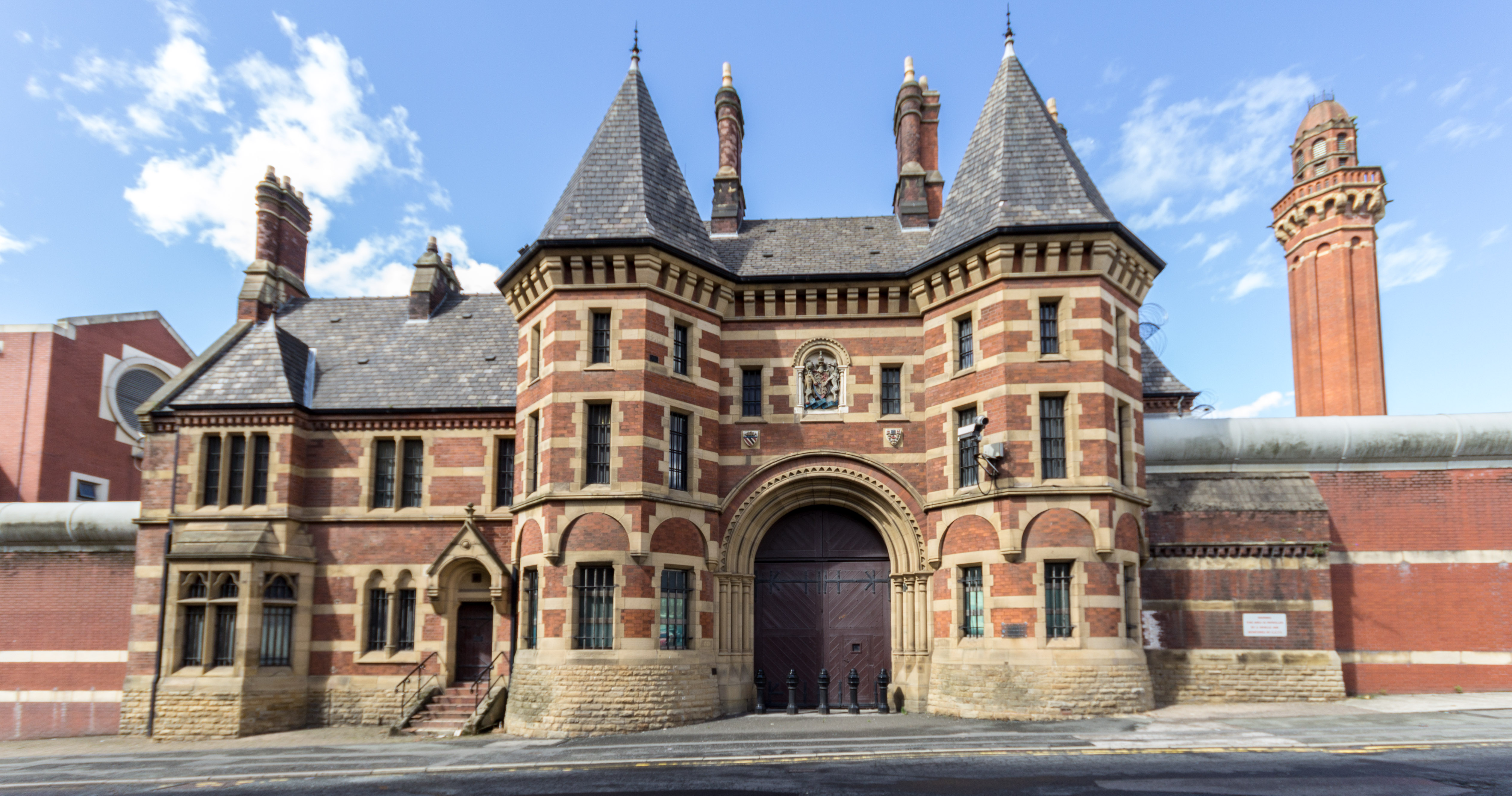
Gallery
From Wikimedia Commons (CC-BY-SA where not otherwise stated).

Photo by Stephen Richards via Wikimedia Commons (CC BY-SA 2.0)

Photo by Alexander P Kapp via Wikimedia Commons (CC BY-SA 2.0)

Photo by Keith Williamson via Wikimedia Commons (CC BY-SA 2.0)

Photo by Keith Williamson via Wikimedia Commons (CC BY-SA 2.0)

Photo by Robert Wade via Wikimedia Commons (CC BY-SA 2.0)

Photo by Robert Wade via Wikimedia Commons (CC BY-SA 2.0)

Photo by Rod Allday via Wikimedia Commons (CC BY-SA 2.0)

Photo by Gene Hunt via Wikimedia Commons (CC BY 3.0)
UK Category A prison operated by HM Prison & Probation Service. Listed in the GOV.UK Find a prison directory.
Background
HM Prison Manchester is a Category A and B men's prison in Manchester, England, operated by His Majesty's Prison Service. It is still commonly referred to as Strangeways, which was its former official name derived from the area in which it is located, until it was rebuilt following a major riot in 1990. The prison is designated as a training prison, having previously been a local prison that accepted those remanded from courts in Greater Manchester. The prison retains a small category A function, located on Echo wing. The prison featured an execution chamber prior to the abolition of capital punishment in the United Kingdom in the 1960s; the last execution at the prison took place in 1964.
Source: Wikipedia article lead, CC-BY-SA.
Capacity
1,052
Current population
—
Occupancy
—
Year opened
1868
Operational
Figures from official sources · verified 29 May 2026 · methodology
Facility profile
Operator
HM Prison & Probation ServicePopulation held
male
Opened
1868
Region
North West England
Security level
Maximum
Death-row facility
No
Conditions
drugs getting in. We want there to be more staff, so they We last inspected Manchester in 2021, when we found that outcomes against sufficiently good for safety, purposeful activity or preparation for release. At this inspection we found a significant deterioration, with outcomes in safety, respect and purposeful activity so poor that I invoked an Urgent Notification to the We found organised criminal activity, serious violence, widespread drug use the proportion of prisoners testing positive for drug use was very high at 39%. We found many examples of poor physical security, including, for example, a arrival of drones delivering illicit packages.
Visiting
social visits in the evenings. We want deaths with a seventh taking place a few weeks after our visit. A further three supervision centre.
Mailing
and prisoners were ripping up foam from mattresses and pillows to push into
Practical info
prison library. work and education. released. sufficiently good for safety, purposeful activity or preparation for release.
Known issues
drugs getting in. We found organised criminal activity, serious violence, widespread drug use the proportion of prisoners testing positive for drug use was very high at 39%. arrival of drones delivering illicit packages. among the most violent in country.
Notable inmates
- Frankie Fraser1923–2014 · autobiographer
Francis Davidson Fraser (13 December 1923 â 26 November 2014), better known as "Mad" Frankie Fraser, was an English gangster who spent 42 years in prison for numerous violent offences.
 Reynhard Sinaga1983
Reynhard "Rey" Tambos Maruli Tua Sinaga (born 19 February 1983) is an Indonesian serial rapist who was convicted of 159 sex offences, including 136 rapes of young men, committed in Manchester, England, between 2015 and 2017, where he was living as a student.
 Buck Ruxton1899–1936 · physician
 Annot Robinson1874–1925 · teacher
Annot Robinson, nicknamed Annie, (née Wilkie; 8 June 1874 â 29 September 1925) was a Scottish suffragette and pacifist.
Source: Wikidata + Wikipedia.
Contact & address
Conditions Risk Score
Derived signal — not a judgement. How it's calculated
- Overcrowding
- 0/30
- Oversight reports
- 12/30
- Structural flags
- 5/15
- Death signals
- 10/15
- Conditions text
- 3/10
What the score is responding to:
- · 2 oversight reports in the last 5 years
- · Substantial documented known-issues record
- · Multiple in-custody-death signals in sources
- · Severe-conditions keyword in sources
This facility scores 30. The national average across 584 scored United Kingdom facilities is 4 — 26 points above national average.
Related facilities
Same country, matched on type + security level where possible.
- HMP BelmarshLondonMaximumCategory A88% occupancy
- HMP WhitemoorMarch, CambridgeshireMaximumCategory A100% occupancy
- HMP Full SuttonYorkMaximumCategory A
- HMP Long LartinWorcestershireMaximumCategory A
- HMP Isle of WightWightMaximumCategory A
- HMP GarthPrestonMaximumCategory A
Compared to other facilities in United Kingdom
583 peersHigher risk than 0% of peer facilities in United Kingdom.
Reports
- HMIP12 Jan 2026
What should the prison do? We want the governor to read the report we wrote about Manchester and make a plan. The plan should tell us how they will fix the problems at Manchester and make things better for prisoners. You can find the report we wrote in the prison library. What do we want to happen? We want the prison to be safe for prisoners and officers. We want the prison to do more to stop drugs getting in. We want officers to only use force on prisoners when they really need to. We want body-worn cameras to be switched on when force is used. We want the prison to do more to help prisoners who might harm themselves. We want prisoners to spend more time in work and education. We want there to be more staff, so they have time to help prisoners. We want the food to be better. We want the prison to be clean and tidy. We want prisoners to get better health care. We want the prison to do more to help prisoners get a job before they are released. We want prisoners to be able to have social visits in the evenings. We want there to be more time for social video calls. What will we do? We will come back in a few years to check how well the prison is doing. We will write a report to tell people what we find. If you have any questions, please write to us: HM Inspectorate of Prisons 3rd floor 10 South Colonnade Canary Wharf London E14 4PU
- HMIP14 Jan 2025
HMP Manchester is a category B training prison, with space for up to 744 long- term prisoners. In addition, it has a specialist function in that it holds small number of category A prisoners, mainly those still going through the court process, and has a close supervision centre, part of a system that holds some of the most disruptive prisoners. At the time of this inspection the prison was holding more than 30 category A prisoners. Many of those held posed a very high risk of harm to others, with 36% serving indeterminate sentences, mainly life. We last inspected Manchester in 2021, when we found that outcomes against our healthy prison test of respect were reasonably good, but that they were not sufficiently good for safety, purposeful activity or preparation for release. At this inspection we found a significant deterioration, with outcomes in safety, respect and purposeful activity so poor that I invoked an Urgent Notification to the Secretary of State. We found organised criminal activity, serious violence, widespread drug use and an officer group that lacked confidence and capability, which had led to a very unstable environment. The number of weapons and other illicit items found in recent months was among the highest of all prisons holding adult men and the proportion of prisoners testing positive for drug use was very high at 39%. We found many examples of poor physical security, including, for example, a failing CCTV system; slow action by HMPPS to install more secure cell windows (which were themselves already being breached); and a failure to replace damaged netting over the exercise yards that might deter the frequent arrival of drones delivering illicit packages. In our survey of prisoners, more than half said they had felt unsafe at some point during their time there and the prison’s own data indicated that it was among the most violent in country. The rate of serious assaults was the highest of all prisons holding adult men and it was continuing to increase. Violence against staff, including serious assaults, was also higher than the average for similar prisons. Since the last inspection, there had been six self-inflicted deaths with a seventh taking place a few weeks after our visit. A further three deaths were suspected to be linked to drug misuse. There had been a steep rise in the rate of self-harm which was now among the highest of all prisons holding adult men. The triggers for self-harm included boredom, drug use, debt and frustration about basic needs not being dealt with by staff. There was too little help given to those in crisis and only 26% of prisoners who had experienced a self-harm crisis said they felt cared for. Hardly any prisoners (3%) thought the culture at the prison encouraged them to behave well and we witnessed a lack of order and control on some wings, with officers failing to challenge very poor, antisocial, or even criminal behaviour. Many officers were new to their role and struggled to manage prisoners effectively while also demonstrating appropriate care and compassion. Some very aggressive attitudes by prisoners were not dealt with robustly and there was little to reward those who tried to behave well. Outdoor areas around the prison were often heavily littered and many of the wings were filthy. Leaders at every level had allowed poor standards of cleanliness to endure, including in the gate lodge, many of the staff rooms and some showers on the wings. Chronic rodent infestation, including rats, persisted – particularly in and around the segregation unit – which was made worse by the amount of food thrown out of windows. Many cell windows were smashed, and prisoners were ripping up foam from mattresses and pillows to push into window frames to stop the cold from getting in. Time out of cell was poor and our survey results were significantly more negative than similar prisons. About a third of officers were routinely unavailable
- HMIP13 Sept 2021
In 2020, HMP Manchester made the transition from a local to a category B training prison, retaining a small category A function and separate close supervision centre. At the time of our visit it held 624 men, of whom a third were serving indeterminate sentences. The governor had taken on the challenge of transforming the culture of the prison and the mindset of the staff to focus on the rehabilitation of long- sentenced prisoners rather than the needs of a transient local prison population, but much of this work had been delayed or derailed by the COVID-19 pandemic. Some material changes had certainly supported this process – all but a few prisoners were held in single cells, showers had been improved and new kitchens on wings would soon mean prisoners could cook their own food. With COVID-19 restrictions still in place, many prisoners were still spending too long in their cells with few jobs available, very limited offending behaviour programmes and face-to-face education practically non-existent. Staff shortages restricted the number of prisoners who could get to the library, gym or workshops. One of the themes of this inspection was the lack of trust that prisoners had in prison staff. For example, they did not believe that complaints would be dealt with robustly, they could not get hold of their stored property, the booking line for visits rang unanswered, there was often no response to applications and the vulnerable prisoners on K wing reported high levels of victimisation from staff. The governor had taken some active steps to address this issue, moving his office and those of senior managers onto the wings to increase their visibility to prisoners and staff. He had put in a new system for managing complaints, brought in new quality assurance to respond to allegations of discrimination and he chaired the black prisoner consultation forum. He had also held a drug summit in which staff and prisoners were consulted on how to reduce the supply of drugs, from which leaders had developed a series of actions. At the last inspection we were very critical of the segregation unit and we were pleased to see improvements not only in the physical environment, but in the way men with often very complex needs were helped back into the main prison, with some impressive input from the psychology service in formulating support plans. The governor had also prioritised improving the staff culture in the prison and the often good and caring interactions we saw with prisoners were evidence that progress was being made. Inspectors who had also been on the previous inspection noticed an improvement in the atmosphere. The prison had recently adopted a new incentive scheme that aimed to improve prisoners’ behaviour, though it was too early to see the effects. Leaders had introduced targeted performance management for custodial managers to improve their confidence and competence in leading their teams; this was crucial to transforming the prison culture. There was, however, much to be done – in some wings, inspectors were struck by the lack of engagement and poor attitudes of some officers. This along with a reluctance to turn on body-worn cameras, the unnecessary use of an aggressive, barking dog to accompany prisoners who were being relocated to the segregation unit, the unwillingness of some staff to challenge disruptive behaviour, the extraordinary strip-searching of prisoners who were being released and the often poor treatment of those at risk of suicide or self-harm, pointed to the scale of the challenge. The board in the administrative block lists the 10 governors who have led the prison since the turn of the century, a turnover rate that explains why so many deep-set problems remain. If HMP Manchester is to make the transformation from a security-focused local prison to a category B training prison that
Data completeness
94%How many of our profile fields are populated. We surface this so families and researchers know the limits.
Sources
- GOV.UK â HMP Manchester
- GOV.UK Find a prison index
- Wikipedia — Wikimedia Foundation
- Find a prison â GOV.UK — UK Ministry of Justice / HMPPS
- HM Inspectorate of Prisons â reports — HMI Prisons (UK)
- GOV.UK Find a prison â collection — UK Ministry of Justice / HMPPS
- Wikidata — Wikimedia Foundation
- Wikidata (Q5635233)
- Wikipedia
- Wikimedia Commons
- See /data-sources for our overall methodology.
Cite this page
Under CC-BY-4.0. Include the URL and access date; the site is a living reference and entries can change.
World Prisons. (2026). HMP Manchester. Retrieved October 20, 2026, from https://worldprisons.com/prisons/hmp-manchester
"HMP Manchester." World Prisons. Accessed October 20, 2026. https://worldprisons.com/prisons/hmp-manchester.
@misc{worldprisons-hmp-manchester,
  author = {{World Prisons}},
  title = {HMP Manchester},
  year = {2026},
  url = {https://worldprisons.com/prisons/hmp-manchester},
  urldate = {2026-10-20}
}