United States · Butts County
Georgia Diagnostic and Classification State Prison
Data is aggregated from public sources and may be incomplete or out of date. Always verify with primary sources before acting on any figure. See data sources.
For families
How to send mail, money, and visit Georgia Diagnostic and Classification State Prison
Step-by-step guidance using the United States system — addresses, money services, visit booking, what to bring on your first visit.
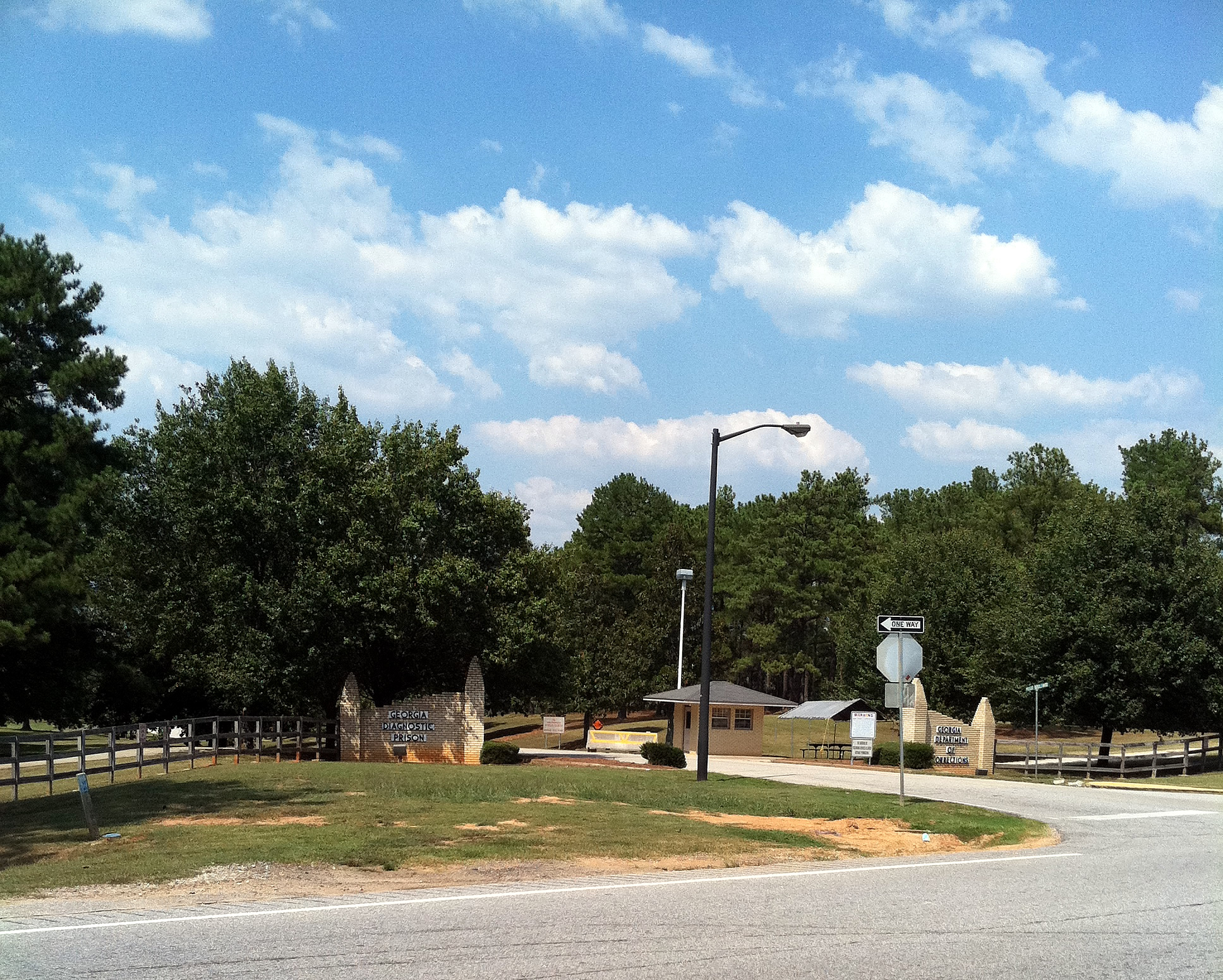
[ [ Men's prison in Georgia, United States Georgia Diagnostic and Classification State Prison (GDCP) Opened in 1969,[\[3\]](https://en.wikipedia.org/wiki/Georgia_Diagnostic_and_Classification_State_Prison#cite_note-3) Georgia Diagnostic and Classification Prison ( GDCP) is a Georgia Department of Corrections prison for men in unincorporated Butts County, Georgia,[\[4\]](https://en.wikipedia.org/wiki/Georgia_Diagnostic_and_Classification_State_Prison#cite_note-4) near Jackson.[\[5\]](https://en.wikipedia.org/wiki/Georgia_Diagnostic_and_Classification_State_Prison#cite_note-5) The prison holds the state execution chamber.
Background
Opened in 1969, Georgia Diagnostic and Classification Prison (GDCP) is a Georgia Department of Corrections prison for men in unincorporated Butts County, Georgia, near Jackson. The prison holds the state execution chamber. The execution equipment was moved to the prison in June 1980, with the first execution in the facility occurring on December 15, 1983. The prison houses the male death row (UDS, "under death sentence"), while female death row inmates reside in Arrendale State Prison. The prison, the largest in the state, consists of eight cellblocks containing both double-bunked and single-bunked cells.
Source: Wikipedia article lead, CC-BY-SA.
Capacity
2,300
Current population
—
Occupancy
—
Year opened
1968
Operational
Figures from official sources · verified 3 Jul 2026 · methodology
Facility profile
Population held
Mixed/unknown
Opened
1968
Region
Butts County
Security level
Maximum
Death-row facility
No
Conditions
No conditions summary available yet.
Visiting
No visiting information available.
Mailing
No mailing information available.
Practical info
Contact the operator's website for inmate-specific procedures.
Known issues
No major issues documented in our database.
Notable inmates
- Denver Fenton Allen1984 · criminal
Source: Wikidata + Wikipedia.
Contact & address
No public contact details available.
Conditions Risk Score
Derived signal — not a judgement. How it's calculated
Related facilities
Same country, matched on type + security level where possible.
- Rikers IslandEast Elmhurst, NYMixedLocal jail42% occupancy
- Franklin County Detention FacilitySt. AlbansMaximumCounty jail660% occupancy
- Gallia County JailGallipolisCounty jail336% occupancy
- Noble County JailCaldwellCounty jail542% occupancy
- Woodman State JailGatesvilleMaximumState prison720% occupancy
- Stark County JailToulonCounty jail3446% occupancy
Compared to other facilities in United States
7436 peersData completeness
42%How many of our profile fields are populated. We surface this so families and researchers know the limits.
Sources
- Wikidata — Wikimedia Foundation
- Wikidata (Q5547458)
- Wikipedia
- See /data-sources for our overall methodology.
Cite this page
Under CC-BY-4.0. Include the URL and access date; the site is a living reference and entries can change.
World Prisons. (2026). Georgia Diagnostic and Classification State Prison. Retrieved October 20, 2026, from https://worldprisons.com/prisons/georgia-diagnostic-and-classification-state-prison
"Georgia Diagnostic and Classification State Prison." World Prisons. Accessed October 20, 2026. https://worldprisons.com/prisons/georgia-diagnostic-and-classification-state-prison.
@misc{worldprisons-georgia-diagnostic-and-clas,
  author = {{World Prisons}},
  title = {Georgia Diagnostic and Classification State Prison},
  year = {2026},
  url = {https://worldprisons.com/prisons/georgia-diagnostic-and-classification-state-prison},
  urldate = {2026-10-20}
}