Germany · Altstadt-Nord
EL-DE Haus
Data is aggregated from public sources and may be incomplete or out of date. Always verify with primary sources before acting on any figure. See data sources.
For families
How to send mail, money, and visit EL-DE Haus
Step-by-step guidance using the Germany system — addresses, money services, visit booking, what to bring on your first visit.

Gallery
From Wikimedia Commons (CC-BY-SA where not otherwise stated).

Photo by Bryan MacKinnon via Wikimedia Commons (CC BY-SA 3.0)

Photo by Raimond Spekking via Wikimedia Commons (CC BY-SA 4.0)
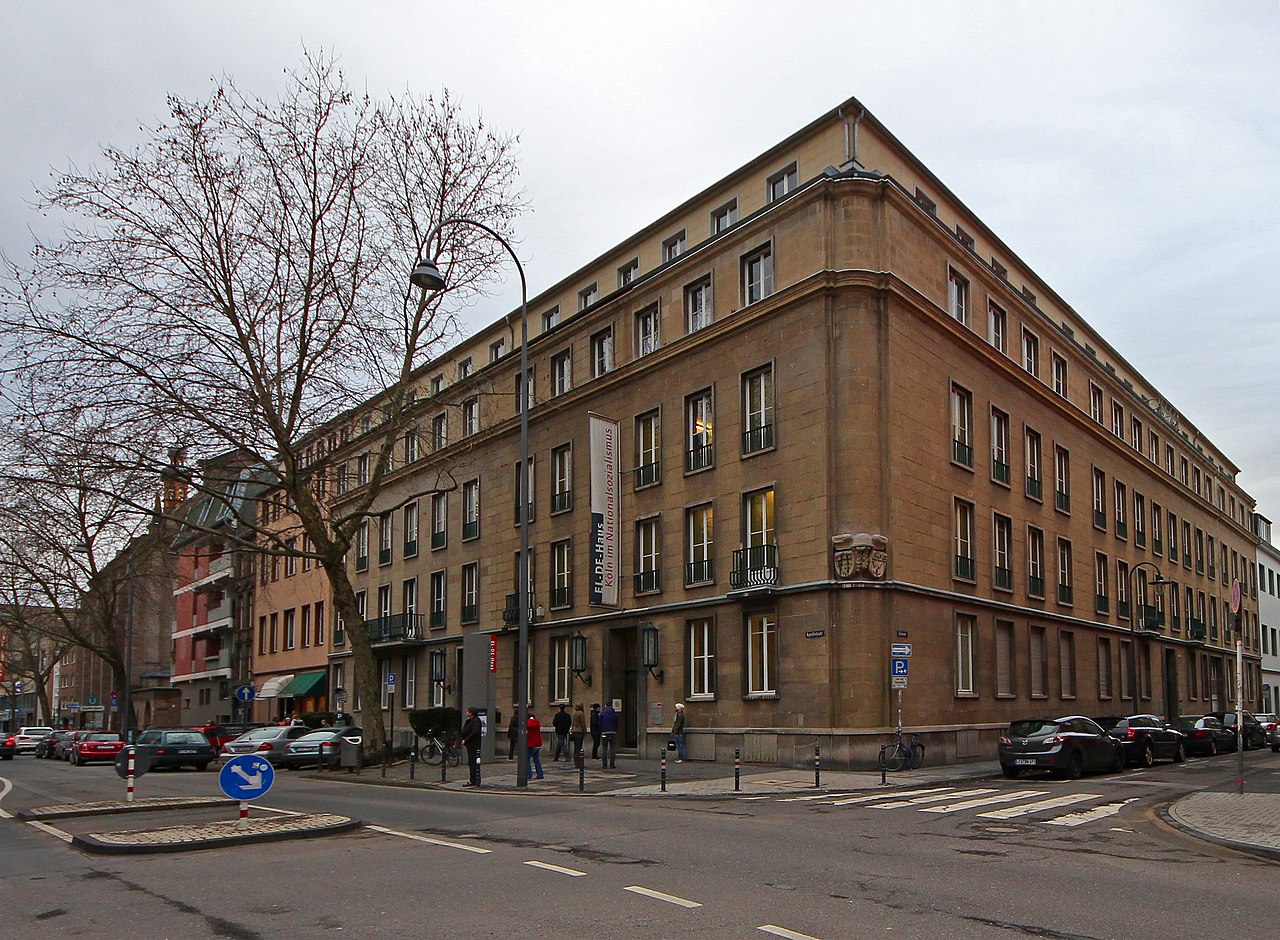
Photo by A.Savin via Wikimedia Commons (CC BY-SA 3.0)

Photo by Raymond - Raimond Spekking via Wikimedia Commons (CC BY-SA 3.0)

Photo by Raymond - Raimond Spekking via Wikimedia Commons (CC BY-SA 3.0)

Photo by © 1971markus via Wikimedia Commons (CC BY-SA 4.0)

Photo by Raimond Spekking via Wikimedia Commons (CC BY-SA 4.0)

Photo by Raimond Spekking via Wikimedia Commons (CC BY-SA 4.0)
Background
EL-DE Haus, officially the NS Documentation Center of the City of Cologne, located in Cologne, is the former headquarters of the Gestapo and now a museum documenting the Third Reich. The building was at first the business premises of jeweller Leopold Dahmen, and the building takes its name from his initials. In 1934, the Nazis rented the building from him and turned it into the headquarters of the secret police, the Gestapo. Surprisingly, the building survived the Allied bombing of Cologne during World War II, while 90% of the city was destroyed. After the bombings, the basements of the building, which had been used as prison cells and torture rooms for forced labourers and political enemies, were used to store wartime files and paperwork.
Source: Wikipedia article lead, CC-BY-SA.
Capacity
—
Current population
—
Occupancy
—
Year opened
—
Operational
Figures from official sources · verified 29 May 2026 · methodology
Facility profile
Operator
—
Population held
Mixed/unknown
Opened
—
Region
Altstadt-Nord
Security level
—
Death-row facility
No
Conditions
No conditions summary available yet.
Visiting
No visiting information available.
Mailing
No mailing information available.
Practical info
Contact the operator's website for inmate-specific procedures.
Known issues
No major issues documented in our database.
Contact & address
Conditions Risk Score
Derived signal — not a judgement. How it's calculated
Related facilities
Same country, matched on type + security level where possible.
- JVA München (Stadelheim)MunichMixedJustizvollzugsanstalt93% occupancy
- Hungerturm Nähe TurmstraÃe in GroÃostheim
- Trebnitz concentration campConcentration camp
- Jugendarrestanstalt NurnbergNürnberg
- Valka-Lager
- Klinik fur Forensische Psychiatrie
Data completeness
20%How many of our profile fields are populated. We surface this so families and researchers know the limits.
Sources
- Wikidata — Wikimedia Foundation
- Wikidata (Q615547)
- Wikipedia
- Wikimedia Commons
- See /data-sources for our overall methodology.
Cite this page
Under CC-BY-4.0. Include the URL and access date; the site is a living reference and entries can change.
World Prisons. (2026). EL-DE Haus. Retrieved October 20, 2026, from https://worldprisons.com/prisons/el-de-haus
"EL-DE Haus." World Prisons. Accessed October 20, 2026. https://worldprisons.com/prisons/el-de-haus.
@misc{worldprisons-el-de-haus,
  author = {{World Prisons}},
  title = {EL-DE Haus},
  year = {2026},
  url = {https://worldprisons.com/prisons/el-de-haus},
  urldate = {2026-10-20}
}