All persons
John Donne
1572–1631
- Nationality
- Kingdom of England
- Occupation
- poet
John Donne ( DUN; 1571 or 1572 â 31 March 1631) was an English poet, scholar, soldier and secretary born into a recusant family, who later became a cleric in the Church of England.
Incarceration history
Facilities
- Fleet PrisonDates unknown
Biography
John Donne ( DUN; 1571 or 1572 â 31 March 1631) was an English poet, scholar, soldier and secretary born into a recusant family, who later became a cleric in the Church of England. Under royal patronage, he was made Dean of St Paul's Cathedral in London (1621â1631). He is considered the preeminent representative of the metaphysical poets. His poetical works are noted for their metaphorical and sensual style and include sonnets, love poems, religious poems, Latin translations, epigrams, elegies, songs and satires. He is also known for his sermons. Donne's style is characterised by abrupt openings and various paradoxes, ironies and dislocations. These features, along with his frequent dramatic or everyday speech rhythms, his tense syntax and his tough eloquence, were both a reaction against the smoothness of conventional Elizabethan poetry and an adaptation into English of European baroque and mannerist techniques. His early career was marked by poetry that bore immense knowledge of English society. A theme in Donne's later poetry is the idea of true religion, something that he spent much time considering and about which he often theorised. He wrote secular poems as well as erotic and love poems. He is particularly famous for his mastery of metaphysical conceits. Despite his great education and poetic talents, Donne lived in poverty for several years, relying heavily on wealthy friends. This was as a result of his secret marriage to Anne More, with whom he eventually had twelve children. He served as a member of Parliament in 1601 and in 1614. In 1615 he unwillingly was ordained Anglican deacon and then priest at the king's insistence.
Related people
Same nationality and era where possible; falls back to shared nationality or era.
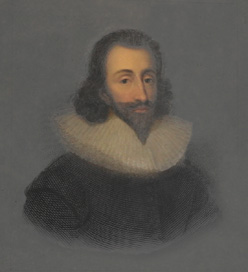 John Eliot1592–1632Kingdom of England
Sir John Eliot (11 April 1592 â 27 November 1632) was an English statesman who was serially imprisoned in the Tower of London, where he eventually died, by King Charles I for advocating the rights and privileges of Parliament.
- Sir Richard Grosvenor, 1st Baronet1585–1645Kingdom of England
Sir Richard Grosvenor, 1st Baronet (9 January 1585 â 14 September 1645) was an English politician who sat in the House of Commons at various times between 1621 and 1629.
 Richard Strode1584–1669Kingdom of England
Sir Richard Strode (25 June 1584 â 9 October 1669) of Newnham, Plympton St Mary, Devon and of Chalmington in Dorset, was a member of the Devonshire gentry who served as MP for Bere Alston in 1604, Bridport in 1626 and for Plympton Erle in 1640.
.jpg) John Greenwood1556–1593Kingdom of England
John Greenwood1556–1593Kingdom of EnglandJohn Greenwood (1556 â 6 April 1593) was an English Separatist Puritan, or Brownist, minister who was executed for his faith.
- John Gerard1564–1637Kingdom of England
John Gerard (4 October 1564 â 27 July 1637) was a priest of the Society of Jesus who operated a secret ministry of the underground Catholic Church in England during the Elizabethan era.