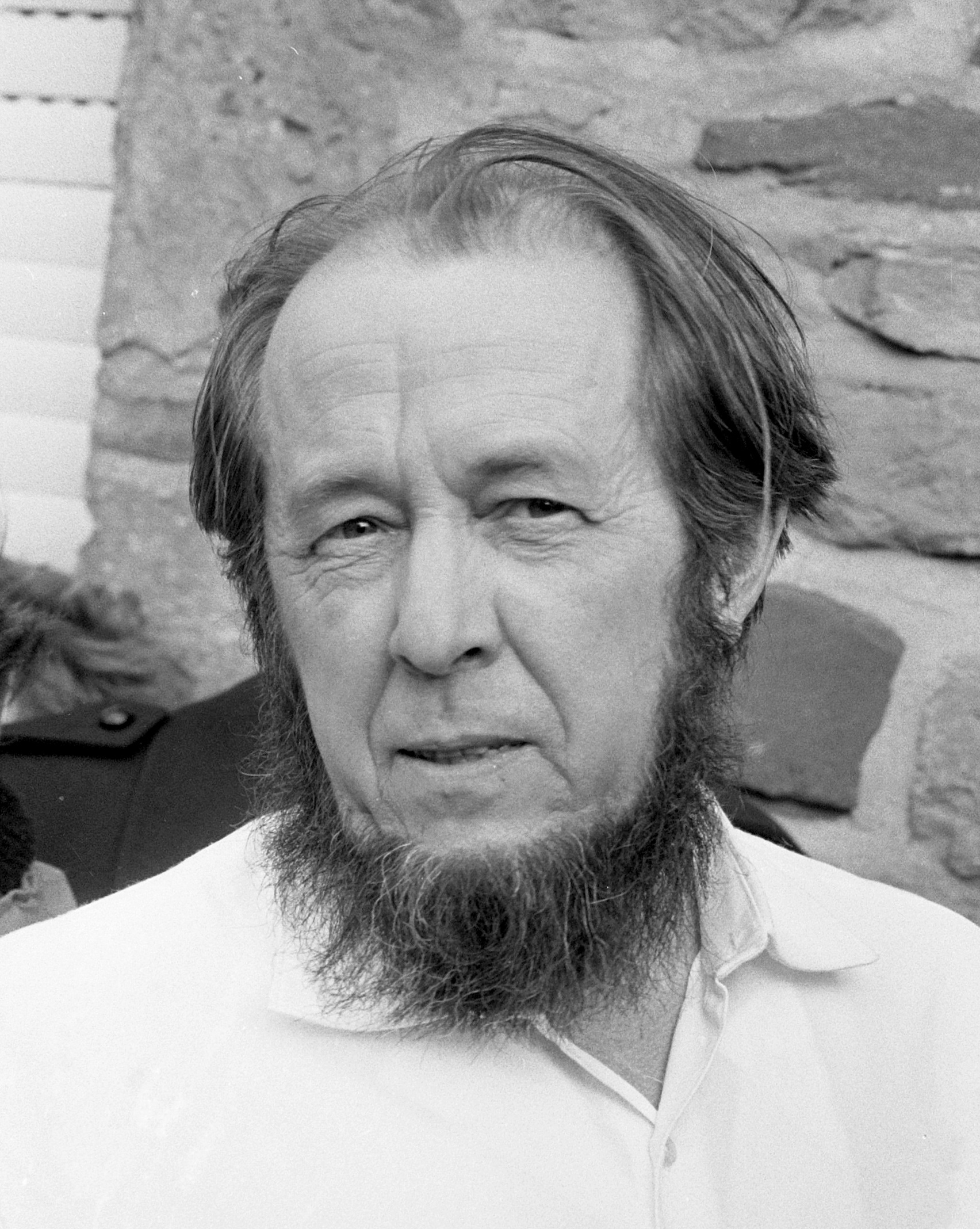
Aleksandr Solzhenitsyn
1918–2008
- Nationality
- Russian Socialist Federative Soviet Republic
- Occupation
- writer
Aleksandr Isayevich Solzhenitsyn (11 December 1918 â 3 August 2008) was a Soviet and Russian author and dissident who helped to raise global awareness of political repression in the Soviet Union, especially the Gulag prison system.
Incarceration history
Facilities
- Lubyanka BuildingDates unknown
- Lefortovo PrisonDates unknown
Biography
Aleksandr Isayevich Solzhenitsyn (11 December 1918 â 3 August 2008) was a Soviet and Russian author and dissident who helped to raise global awareness of political repression in the Soviet Union, especially the Gulag prison system. He was awarded the 1970 Nobel Prize in Literature "for the ethical force with which he has pursued the indispensable traditions of Russian literature". His nonfiction work The Gulag Archipelago "amounted to a head-on challenge to the Soviet state" and sold tens of millions of copies. Solzhenitsyn was born into a family that defied the Soviet anti-religious campaign in the 1920s and remained devout members of the Russian Orthodox Church. At a young age he became an atheist and embraced MarxismâLeninism. While serving as a captain in the Red Army during World War II, Solzhenitsyn was arrested by SMERSH and sentenced to eight years in the Gulag and then internal exile for criticizing Joseph Stalin in private correspondence with another field officer. As a result of his experience in prison and the camps, he gradually became a philosophically minded Eastern Orthodox Christian. During the Khrushchev Thaw, Solzhenitsyn was released and exonerated. He started writing novels about his experiences and repression in the Soviet Union. In 1962, he published his first novel, One Day in the Life of Ivan Denisovichâan account of Stalinist repressionsâwith approval from Soviet leader Nikita Khrushchev. His last work to be published in the Soviet Union was Matryona's Place in 1963. After Khrushchev lost power, Soviet authorities unsuccessfully tried to discourage Solzhenitsyn from writing. His novels published in other countries included Cancer Ward in 1966, In the First Circle in 1968, August 1914 in 1971 and The Gulag Archipelago in 1973. The last outraged authorities and, in 1974, he was stripped of his Soviet citizenship and flown to West Germany. He soon moved to Switzerland and then, in 1976, to Vermont in the United States with his family. During his tour of the United States, Aleksandr Solzhenitsyn visited St. Nicholas Old Believer Orthodox Church in Millville, New Jersey in December 1976, and spoke to a congregation of 50 people in the Russian language about pride in religion and religious activities which were restricted in the Soviet Union. He continued to write and his Soviet citizenship was restored in 1990. He returned to Russia four years later and remained there until his death in 2008.
Related people
Same nationality and era where possible; falls back to shared nationality or era.
 Jan Bialostocki1921–1988Russian Socialist Federative Soviet Republic
Jan BiaÅostocki (Polish: [Ëjan bjawÉËstÉtÍ¡skʲi]; August 14, 1921 â December 25, 1988) was a Polish historian who was born in Saratov, Russia and died in Warsaw.
 Ãlvaro Cunhal1913–2005Portugal
Ãlvaro Barreirinhas Cunhal (Portuguese pronunciation: [ËalvÉɾu kuËɲal]; 10 November 1913 â 13 June 2005) was a Portuguese leftist revolutionary and politician.
- Viktor Lederer1905Czechoslovakia
 Wojciech Zamecznik1923–1967Poland
Wojciech Zamecznik (13 January 1923 in Warsaw â 12 May 1967 in Warsaw) was a Polish graphic artist, architect, photographer and interior designer. Zamecznik's most notable works are movie and socio-political posters.
 Robert Ploton1901–1975France
 Miloslav Löbl1926–1942