Heptapyrgion
Data is aggregated from public sources and may be incomplete or out of date. Always verify with primary sources before acting on any figure. See data sources.
For families
How to send mail, money, and visit Heptapyrgion
Step-by-step guidance using the Greece system — addresses, money services, visit booking, what to bring on your first visit.

Gallery
From Wikimedia Commons (CC-BY-SA where not otherwise stated).
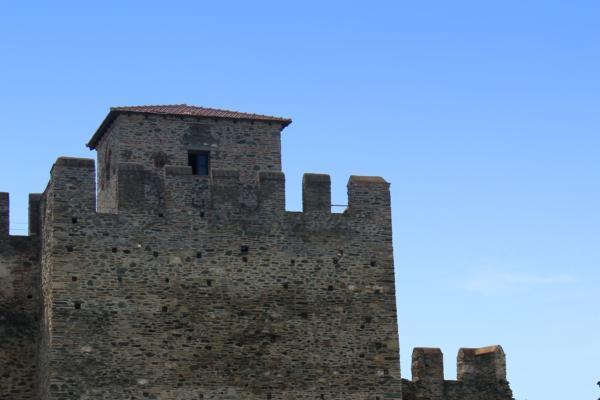
Photo by Wrto12 via Wikimedia Commons (CC BY-SA 3.0)

Photo by Nikolai Bulykin via Wikimedia Commons (CC BY-SA 4.0)

Photo by Nikolai Bulykin via Wikimedia Commons (CC BY-SA 4.0)

Photo by Unknown authorUnknown author via Wikimedia Commons (Public domain)

Photo by Mister No via Wikimedia Commons (CC BY 3.0)

Photo by Mister No via Wikimedia Commons (CC BY 3.0)

Photo by Mister No via Wikimedia Commons (CC BY 3.0)

Photo by G.Garitan via Wikimedia Commons (CC BY-SA 4.0)
Background
The Heptapyrgion (Medieval Greek: á¼ÏÏαÏÏÏγιον [eptaËpirÊion]), modern Eptapyrgio (Greek: ÎÏÏαÏÏÏγιο [eptaËpirÊio]), also popularly known by its Ottoman Turkish name Yedi Kule (ÛØ¯Û ÙÙÙ yedikulle; ÎενÏί ÎÎ¿Ï Î»Î), is a Byzantine and Ottoman-era fortress situated on the north-eastern corner of the Acropolis of Thessaloniki in Greece. Despite its name, which in both languages means "Fortress of Seven Towers", it features ten, and was probably named after the Yedikule Fortress in Constantinople (modern Istanbul, Turkey). It served as the major redoubt of the city's acropolis, as well as the seat of its garrison commander in Ottoman times, until the late 19th century. It was then converted to a prison (Î¦Ï Î»Î±ÎºÎÏ ÎÏÏαÏÏ ÏÎ³Î¯Î¿Ï ), which remained open until 1989. References to the infamous Yedi Kule prison abound in the Greek rebetika songs.
Source: Wikipedia article lead, CC-BY-SA.
Capacity
—
Current population
—
Occupancy
—
Year opened
—
Operational
Figures from official sources · verified 29 May 2026 · methodology
Facility profile
Operator
—
Population held
Mixed/unknown
Opened
—
Region
—
Security level
—
Death-row facility
No
Conditions
No conditions summary available yet.
Visiting
No visiting information available.
Mailing
No mailing information available.
Practical info
Contact the operator's website for inmate-specific procedures.
Known issues
No major issues documented in our database.
Notable inmates
 Nikolaos Davelis1880 · military personnel
Nikolaos Davelis (Greek: ÎικÏÎ»Î±Î¿Ï ÎÏαβÎληÏ) was a significant Greek participant in the Macedonian Struggle.
- Andreas Tzimas1909–1972 · politician
Source: Wikidata + Wikipedia.
Contact & address
No public contact details available.
Conditions Risk Score
Derived signal — not a judgement. How it's calculated
Related facilities
Same country, matched on type + security level where possible.
Data completeness
16%How many of our profile fields are populated. We surface this so families and researchers know the limits.
Sources
- Wikipedia — Wikimedia Foundation
- Wikidata — Wikimedia Foundation
- Wikidata (Q1572213)
- Wikipedia
- Wikimedia Commons
- See /data-sources for our overall methodology.
Cite this page
Under CC-BY-4.0. Include the URL and access date; the site is a living reference and entries can change.
World Prisons. (2026). Heptapyrgion. Retrieved October 20, 2026, from https://worldprisons.com/prisons/heptapyrgion
"Heptapyrgion." World Prisons. Accessed October 20, 2026. https://worldprisons.com/prisons/heptapyrgion.
@misc{worldprisons-heptapyrgion,
  author = {{World Prisons}},
  title = {Heptapyrgion},
  year = {2026},
  url = {https://worldprisons.com/prisons/heptapyrgion},
  urldate = {2026-10-20}
}