Hay Gaol
Data is aggregated from public sources and may be incomplete or out of date. Always verify with primary sources before acting on any figure. See data sources.
For families
How to send mail, money, and visit Hay Gaol
Step-by-step guidance using the Australia system — addresses, money services, visit booking, what to bring on your first visit.
Gallery
From Wikimedia Commons (CC-BY-SA where not otherwise stated).

Photo by Naomi Nelson via Wikimedia Commons (CC BY 4.0)

Photo by Heritage Division via Wikimedia Commons (CC BY 4.0)

Photo by Photographic Collection via Wikimedia Commons (CC BY 2.0)

Photo by Peterdownunder via Wikimedia Commons (CC BY-SA 3.0)

Photo by Unknown via Wikimedia Commons (Public domain)

Photo by Mattinbgn/talk via Wikimedia Commons (CC BY-SA 3.0)

Photo by Mattinbgn/talk via Wikimedia Commons (CC BY-SA 3.0)
Background
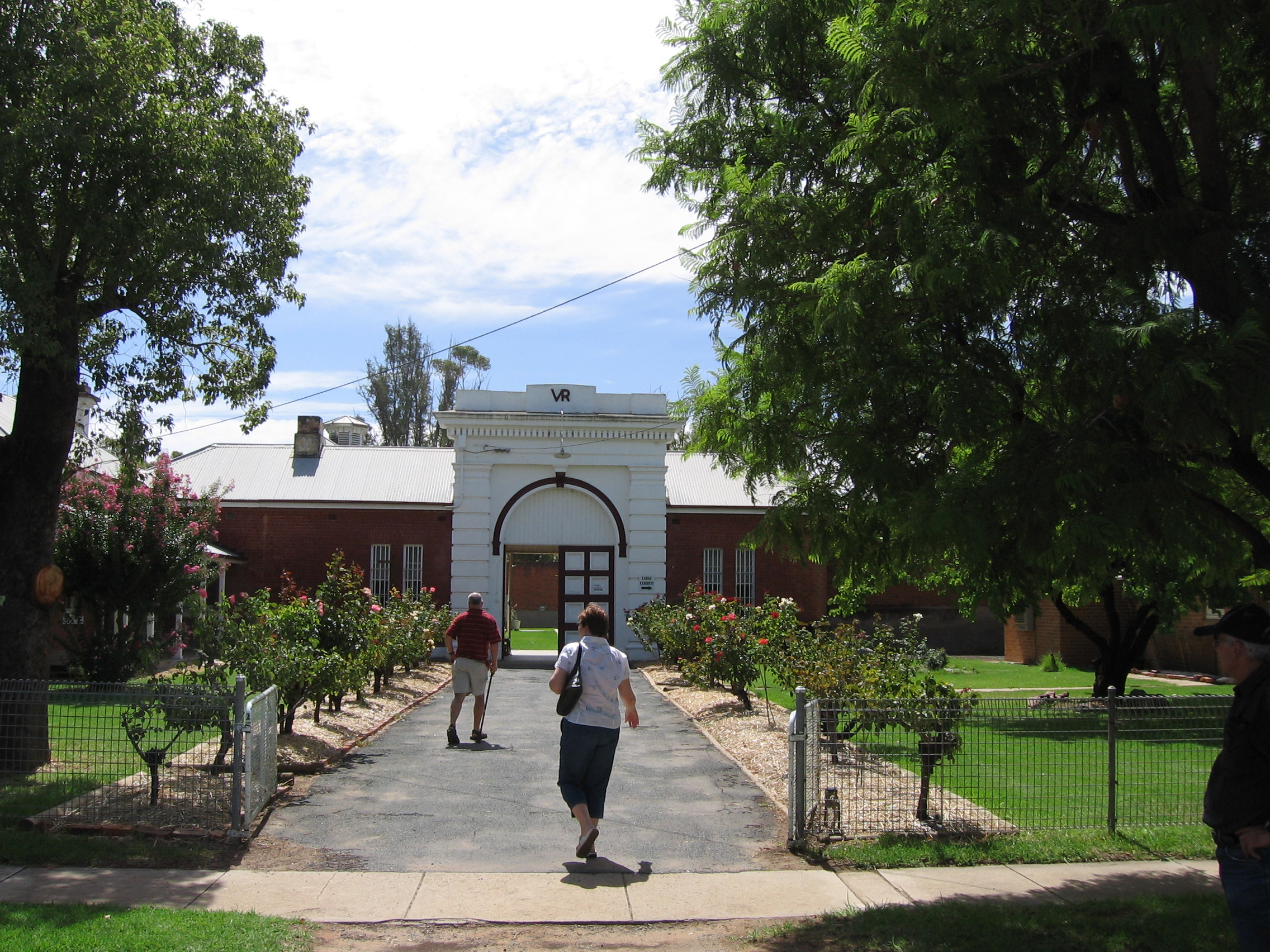
The Hay Gaol is a heritage-listed former prison and now museum at 355 Church Street, Hay, in the Riverina region of New South Wales, Australia. It was an adult prison from 1880 to 1915 and 1930 until 1940, a prisoner-of-war camp during World War II, and a juvenile facility, the Hay Institution for Girls, from 1961 to 1974. It was designed by James Barnet and Colonial Architect and built from 1879 to 1880 by Witcombe Brothers. The site faces Church Street, and is otherwise bounded by Piper, Macauley and Coke Streets, north-east of the town centre. It was added to the New South Wales State Heritage Register on 13 March 2009.
Source: Wikipedia article lead, CC-BY-SA.
Capacity
—
Current population
—
Occupancy
—
Year opened
1879
Operational
Figures from official sources · verified 29 May 2026 · methodology
Facility profile
Operator
—
Population held
Mixed/unknown
Opened
1879
Region
—
Security level
High-security
Death-row facility
No
Conditions
No conditions summary available yet.
Visiting
No visiting information available.
Mailing
No mailing information available.
Practical info
Contact the operator's website for inmate-specific procedures.
Known issues
No major issues documented in our database.
Contact & address
No public contact details available.
Conditions Risk Score
Derived signal — not a judgement. How it's calculated
Related facilities
Same country, matched on type + security level where possible.
- Barwon PrisonLara, VictoriaMaximumState maximum-security93% occupancy
- Long Bay Correctional ComplexMalabar, SydneyMixedState complex98% occupancy
- South Coast Correctional CentreNowra HillMixedMinimum to maximum security
- Langi Kal Kal PrisonLangi Kal KalMinimumMinimum security
- Ouyen Community Correction Services
- Acacia PrisonWoorolooMediumMedium security
Data completeness
24%How many of our profile fields are populated. We surface this so families and researchers know the limits.
Sources
- Wikipedia — Wikimedia Foundation
- Wikidata — Wikimedia Foundation
- Wikidata (Q5685789)
- Wikipedia
- Wikimedia Commons
- See /data-sources for our overall methodology.
Cite this page
Under CC-BY-4.0. Include the URL and access date; the site is a living reference and entries can change.
World Prisons. (2026). Hay Gaol. Retrieved October 20, 2026, from https://worldprisons.com/prisons/hay-gaol
"Hay Gaol." World Prisons. Accessed October 20, 2026. https://worldprisons.com/prisons/hay-gaol.
@misc{worldprisons-hay-gaol,
  author = {{World Prisons}},
  title = {Hay Gaol},
  year = {2026},
  url = {https://worldprisons.com/prisons/hay-gaol},
  urldate = {2026-10-20}
}