Camp Ashcan
Data is aggregated from public sources and may be incomplete or out of date. Always verify with primary sources before acting on any figure. See data sources.
For families
How to send mail, money, and visit Camp Ashcan
Step-by-step guidance using the Luxembourg system — addresses, money services, visit booking, what to bring on your first visit.

Gallery
From Wikimedia Commons (CC-BY-SA where not otherwise stated).
Photo by Unknown. Given that the image was taken in a heavily guarded, top-secret U.S. Army POW camp housing top Nazi war criminals, it is difficult to conceive that the photo was taken by a person who was not a U.S. armed forces member or other U.S. government employee. via Wikimedia Commons (Public domain)

Photo by Ãditions W. Capus, Luxembourg via Wikimedia Commons (Public domain)
geheimes Gefangenenlager der Alliierten unter US-amerikanischer Führung Ende des Zweiten Weltkrieges in Bad Mondorf (Luxemburg)
Background
Central Continental Prisoner of War Enclosure No. 32, code-named Ashcan, was an Allied prisoner-of-war camp in the Palace Hotel of Mondorf-les-Bains, Luxembourg during World War II. Operating from May to August 1945, it served as a processing station and interrogation center for the 86 most prominent surviving Nazi leaders prior to their trial in Nuremberg, including Hermann Göring and Karl Dönitz. A British counterpart of Ashcan, Camp Dustbin in Castle Kransberg near Frankfurt am Main, housed prisoners of a more technical inclination including Albert Speer and Wernher von Braun.
Source: Wikipedia article lead, CC-BY-SA.
Capacity
—
Current population
—
Occupancy
—
Year opened
1945
Closed 1945
Figures from official sources · verified 29 May 2026 · methodology
Facility profile
Operator
—
Population held
Mixed/unknown
Opened
1945
Region
—
Security level
—
Death-row facility
No
Conditions
No conditions summary available yet.
Visiting
No visiting information available.
Mailing
No mailing information available.
Practical info
Contact the operator's website for inmate-specific procedures.
Known issues
No major issues documented in our database.
Notable inmates
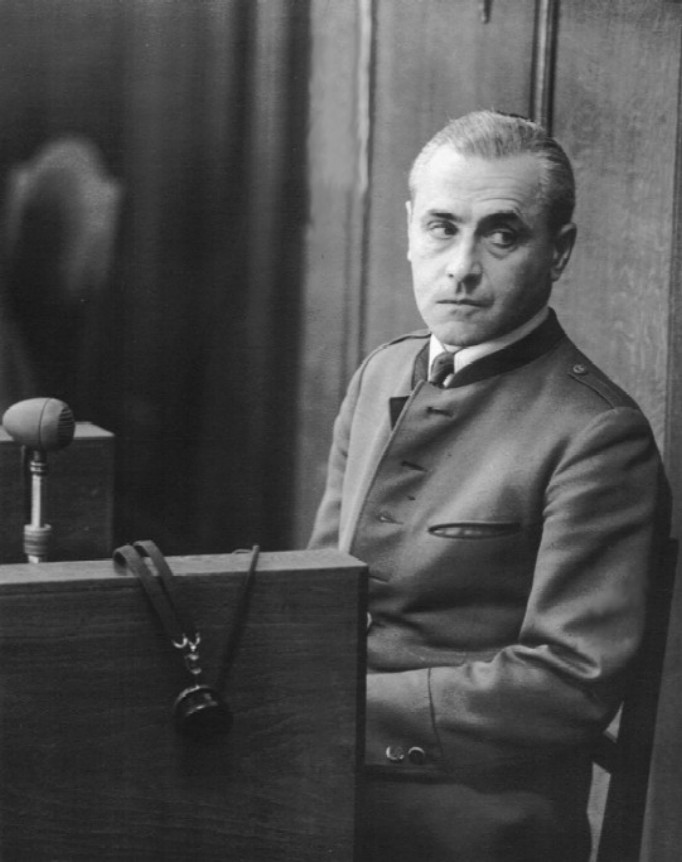 Walter Warlimont1894–1976 · military officer
Walter Warlimont (WAH-li-moh; 3 October 1894 â 9 October 1976) was a German Army staff officer and general during World War II.
 Franz Xaver Schwarz1875–1947 · politician
Franz Xaver Schwarz (27 November 1875 â 2 December 1947) was a high ranking German Nazi Party official who served as Reichsschatzmeister (National Treasurer) of the Party throughout most of its existence.
.jpg) Franz Ritter von Epp1868–1947 · politician
Franz Ritter von Epp1868–1947 · politicianFranz Ritter von Epp (born Franz Epp; from 1918 as Ritter von Epp; 16 October 1868 â 31 January 1947) was a German general and politician who started his military career in the Bavarian Army.
- Walter Warlimont1894–1976 · military officer
Walter Warlimont (WAH-li-moh; 3 October 1894 â 9 October 1976) was a German Army staff officer and general during World War II.
 Hermann Göring1893–1946 · politician
Hermann Wilhelm Göring (or Goering; German: [ËhÉÊman ËvɪlhÉlm ËɡøËÊɪÅ] ; 12 January 1893 â 15 October 1946) was a German politician, aviator, military commander, and convicted war criminal.
Source: Wikidata + Wikipedia.
Contact & address
No public contact details available.
Conditions Risk Score
Derived signal — not a judgement. How it's calculated
Related facilities
Same country, matched on type + security level where possible.
Data completeness
24%How many of our profile fields are populated. We surface this so families and researchers know the limits.
Sources
- Wikipedia — Wikimedia Foundation
- Wikidata — Wikimedia Foundation
- Wikidata (Q881001)
- Wikipedia
- Wikimedia Commons
- See /data-sources for our overall methodology.
Cite this page
Under CC-BY-4.0. Include the URL and access date; the site is a living reference and entries can change.
World Prisons. (2026). Camp Ashcan. Retrieved October 15, 2026, from https://worldprisons.com/prisons/camp-ashcan
"Camp Ashcan." World Prisons. Accessed October 15, 2026. https://worldprisons.com/prisons/camp-ashcan.
@misc{worldprisons-camp-ashcan,
  author = {{World Prisons}},
  title = {Camp Ashcan},
  year = {2026},
  url = {https://worldprisons.com/prisons/camp-ashcan},
  urldate = {2026-10-15}
}