Russia · Novy Akatuy
Akatuy katorga
Data is aggregated from public sources and may be incomplete or out of date. Always verify with primary sources before acting on any figure. See data sources.
For families
How to send mail, money, and visit Akatuy katorga
Step-by-step guidance using the Russia system — addresses, money services, visit booking, what to bring on your first visit.
Gallery
From Wikimedia Commons (CC-BY-SA where not otherwise stated).
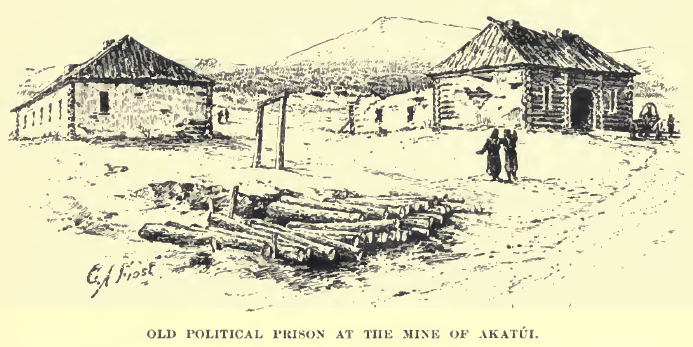
Photo by George A. Frost via Wikimedia Commons (Public domain)

Photo by ÐÑедположиÑелÑно Ð.Ð.ÐÑзнеÑов via Wikimedia Commons (Public domain)
Photo by Kuznetsov, A.K. via Wikimedia Commons (Public domain)
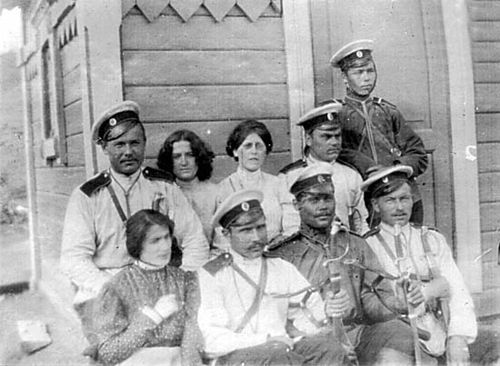
Photo by Not stated via Wikimedia Commons (Public domain)

Photo by Unknown authorUnknown author via Wikimedia Commons (Public domain)
Background
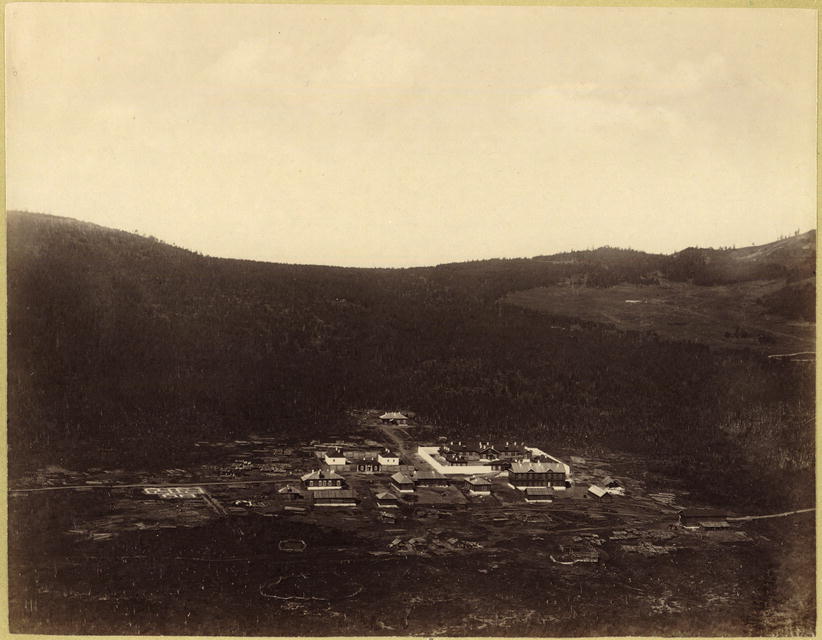
The Akatuy katorga prison (Russian: ÐкаÑÑйÑÐºÐ°Ñ ÐºÐ°ÑоÑÐ¶Ð½Ð°Ñ ÑÑÑÑма, Akatuyskaya katorzhnaya tyur'ma), part of the Nerchinsk katorga system of the Russian Empire, operated in the present-day Alexandrovo-Zavodsky District of Transbaikalia in the Russian Far East. It originated in 1832 at the Akatuyskiy mine in the village of New Akatuy (Russian: ÐовÑй ÐкаÑÑй). Originally labor convicts (mostly criminal) worked here extracting of lead-silver ores. After the closing of the Kara katorga in 1890, Akatuy became one of the main centers for the detention of political prisoners. It became a women's penal camp in 1911 and finally closed after the February Revolution of 1917.
Source: Wikipedia article lead, CC-BY-SA.
Capacity
—
Current population
—
Occupancy
—
Year opened
1832
Closed 1917
Figures from official sources · verified 29 May 2026 · methodology
Facility profile
Operator
—
Population held
Mixed/unknown
Opened
1832
Region
Novy Akatuy
Security level
—
Death-row facility
No
Conditions
No conditions summary available yet.
Visiting
No visiting information available.
Mailing
No mailing information available.
Practical info
Contact the operator's website for inmate-specific procedures.
Known issues
No major issues documented in our database.
Notable inmates
 Mikhail Lunin1787–1845 · philosopher
Source: Wikidata + Wikipedia.
Contact & address
No public contact details available.
Conditions Risk Score
Derived signal — not a judgement. How it's calculated
Related facilities
Same country, matched on type + security level where possible.
- IK-3 'Polar Wolf'KharpSpecial regimeFederal penal colony
- Black Dolphin Prison (IK-6)Sol-IletskSupermaxFederal penal colony100% occupancy
- Karachev concentration campConcentration camp
- FKU «SIZO № 2 UFSIN Rossii po RK»Сосногорск , п. Лыаёльpretrial-detention
- Pivnichne Upravlinnia VTT ta budivnitstvo 503
- Budivnitstvo 510 i VTT
Data completeness
16%How many of our profile fields are populated. We surface this so families and researchers know the limits.
Sources
- Wikipedia — Wikimedia Foundation
- Wikidata — Wikimedia Foundation
- Wikidata (Q2377435)
- Wikipedia
- Wikimedia Commons
- See /data-sources for our overall methodology.
Cite this page
Under CC-BY-4.0. Include the URL and access date; the site is a living reference and entries can change.
World Prisons. (2026). Akatuy katorga. Retrieved October 15, 2026, from https://worldprisons.com/prisons/akatuy-katorga
"Akatuy katorga." World Prisons. Accessed October 15, 2026. https://worldprisons.com/prisons/akatuy-katorga.
@misc{worldprisons-akatuy-katorga,
  author = {{World Prisons}},
  title = {Akatuy katorga},
  year = {2026},
  url = {https://worldprisons.com/prisons/akatuy-katorga},
  urldate = {2026-10-15}
}