
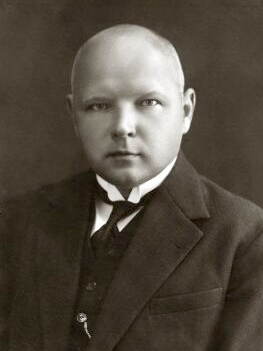
Vaclovas Sidzikauskas
1893–1973
- Nationality
- Lithuania
- Occupation
- jurist
Vaclovas Sidzikauskas (10 April 1893 â 2 December 1973) was a prominent diplomat in interwar Lithuania and post-war anti-communist. Educated at the University of Fribourg and Moscow Imperial University, Sidzikauskas joined the newly established Lithuanian Ministry of Justice.
Incarceration history
Facilities
- Zigeunerlager AuschwitzDates unknown
- Zigeunerlager AuschwitzDates unknown
Biography
Vaclovas Sidzikauskas (10 April 1893 â 2 December 1973) was a prominent diplomat in interwar Lithuania and post-war anti-communist. Educated at the University of Fribourg and Moscow Imperial University, Sidzikauskas joined the newly established Lithuanian Ministry of Justice. In October 1919, he was sent to Switzerland and, after the resignations of Jurgis Å aulys, became the Lithuanian diplomatic representative to Switzerland and a member of several Lithuanian delegations to the League of Nations. Sidzikauskas was transferred as the Lithuanian representative in Berlin in June 1922. The position became a key posting in Lithuanian foreign affairs after the KlaipÄda Revolt in January 1923. He was one of the negotiators of the KlaipÄda Convention which recognized KlaipÄda Region (Memelland) as an autonomous part of Lithuania. When conflicts arose with Germany over the interpretation of the convention, Sidzikauskas negotiated with German officials and represented Lithuania at the League of Nations. Twice, in 1926 and 1931, Sidzikauskas represented Lithuania at the Permanent Court of International Justice. In October 1931, he was transferred to London. His diplomatic career was cut short by a corruption scandal. Convicted of misappropriation of funds, Sidzikauskas resigned from diplomatic posts in November 1934. He became director of the Lithuanian subsidiary of the Shell Oil Company in 1936 and joined Lithuanian cultural life by contributing articles to Lithuanian press and chairing the Union of Lithuanian West (Lietuvos vakarų sÄ junga) which sought to strengthen cultural ties between the KlaipÄda Region and Lithuania. After the occupation of Lithuania by the Soviet Union in June 1940, NKVD attempted to recruit Sidzikauskas as an agent. He fled to Nazi Germany where he spent 20 months in the Soldau and Auschwitz concentration camps. He was freed with the help of his old diplomatic contacts. At the end of the war, he joined the Supreme Committee for the Liberation of Lithuania (VLIK) and in 1947 became chairman of its Executive Council which had aspirations of becoming the Lithuanian government-in-exile. These ambitions soured the relationship between VLIK and the Lithuanian Diplomatic Service. In 1950, Sidzikauskas moved to United States and became active in various anti-communist organizations. In 1951, he became chairman of the Committee for a Free Lithuania, an initiative of the National Committee for a Free Europe, and chaired it until his death in 1973. He also briefly chaired the Assembly of Captive European Nations (twice, in 1960â1961 and 1965â1966) and VLIK (1964â1966).
Related people
Same nationality and era where possible; falls back to shared nationality or era.
 Antanas Merkys1887–1955Lithuania
Antanas Merkys (; 1 February 1887 â 5 March 1955) was the last Prime Minister of independent Lithuania, serving from November 1939 to June 1940.
- Vladas Niunka1907–1983Lithuania
Vladas Niunka (17 August 1907 â 26 December 1983) was a Lithuanian communist politician and publicist.
- Stefan Plater-Zyberk1891–1942Lithuania
 Vladas Jurgutis1885–1966Lithuania
Vladas Jurgutis (17 November 1885 in Joskaudai near Palanga â 9 January 1966 in Vilnius) was a Lithuanian priest, economist, and professor.
 Stasys Å ilingas1885–1962Lithuania
Baron Stasys Å ilingas (11 November 1885 â 13 November 1962) was a prominent lawyer and statesman in interwar Lithuania. When the independence of Lithuania was proclaimed on February 16, 1918, Å ilingas served first as vice-president and then in 1919, as president of the Council of Lithuania.
.jpg) Aleksandras Stulginskis1885–1969Lithuania
Aleksandras Stulginskis1885–1969LithuaniaAleksandras Stulginskis [ÉlʲÉkËsÉÌËndrÉs stÊlʲËɡʲɪÌnʲsʲkʲɪs] (26 February 1885 â 22 September 1969) was the second President of Lithuania (1920â1926).