All persons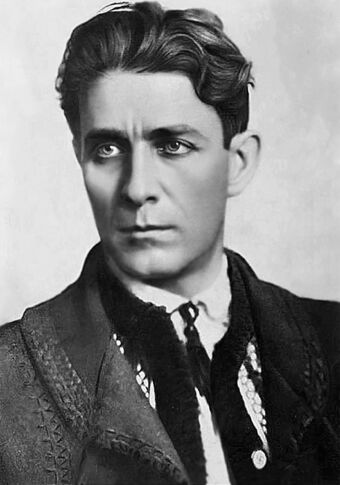
Corneliu Zelea Codreanu
1899–1938
- Nationality
- Romania
- Occupation
- politician
Incarceration history
Facilities
- Doftana prisonDates unknown
- Jilava prisonDates unknown
Biography
Corneliu Zelea Codreanu (Romanian: [korËnelju Ëzele̯a koËdre̯anu] ; 13 September 1899 â 30 November 1938), born Corneliu Zelinski and commonly known as Corneliu Codreanu, was a fascist Romanian politician, the founder and charismatic leader of the Iron Guard or The Legion of the Archangel Michael (also known as the Legionary Movement), an ultranationalist and violently antisemitic organization active throughout most of the interwar period. Generally seen as the main variety of local fascism, and noted for its mystical and Romanian Orthodox-inspired revolutionary message, the Iron Guard gained prominence on the Romanian political stage, coming into conflict with the political establishment and the democratic forces, and often resorting to terrorism. The Legionnaires traditionally referred to Codreanu as CÄpitanul ("The Captain"), and he held absolute authority over the organization until his death. Codreanu, who began his career in the wake of World War I as an anticommunist and antisemitic agitator associated with A. C. Cuza and Constantin Pancu, was a co-founder of the National-Christian Defense League and assassin of the IaÈi Police prefect Constantin Manciu. Codreanu left Cuza to found a succession of movements on the far right, rallying around him a growing segment of the country's intelligentsia and peasant population, and inciting pogroms in various parts of Greater Romania. Several times outlawed by successive Romanian cabinets, his Legion assumed different names and survived in the underground, during which time Codreanu formally delegated leadership to Gheorghe Cantacuzino-GrÄnicerul. Following Codreanu's instructions, the Legion carried out assassinations of politicians it viewed as corrupt, including Premier Ion G. Duca and his former associate Mihai Stelescu. Simultaneously, Corneliu Zelea Codreanu advocated Romania's adherence to a military and political alliance with Nazi Germany. During the 1937 election, his party registered its strongest showing, placing third and winning 15.8% of the vote. It was kept from power by King Carol II, who invited the rival fascists and fourth-place finishers of the National Christian Party to form a short-lived government, succeeded by the National Renaissance Front royal dictatorship. The rivalry between Codreanu and, on the other side, Carol and moderate politicians like Nicolae Iorga ended with Codreanu's incarceration at Jilava Prison and eventual execution at the hands of the Gendarmerie. He was succeeded as leader by Horia Sima. In 1940, under the National Legionary State proclaimed by the Iron Guard, his killing served as the basis for violent retribution. Corneliu Zelea Codreanu's views influenced the modern far right. Groups claiming him as a forerunner include Noua DreaptÄ and other Romanian successors of the Iron Guard, the International Third Position, and various neofascist organizations in Italy and other parts of Europe.
Related people
Same nationality and era where possible; falls back to shared nationality or era.
 Virgil Carianopol1908–1984Romania
Virgil Carianopol (March 29, 1908âApril 6, 1984) was a Romanian poet. Born in Caracal, his parents were Grigore Carianopol, a court clerk, and his wife Atena (née Popescu).
 Ètefan TÄtÄrescu1890–1969Romania
 Gheorghe Jijie1919–2012Romania
 Isac Peltz1899–1980Romania
Isac Peltz or IÈic Peltz (12 February 1899 â 10 August 1980) was a Romanian prose writer and journalist.
- Savu Petra Dan1903–1986Romania
 Constant Tonegaru1919–1952Romania
Constant Tonegaru (common rendition of Constantin Tonegaru; February 26, 1919 â February 10, 1952) was a Romanian avant-garde and Decadent poet, who ended his career as a political prisoner and victim of the communist regime.